
The 'ACD Model'
The Authentic - Conditioned, Directional Model
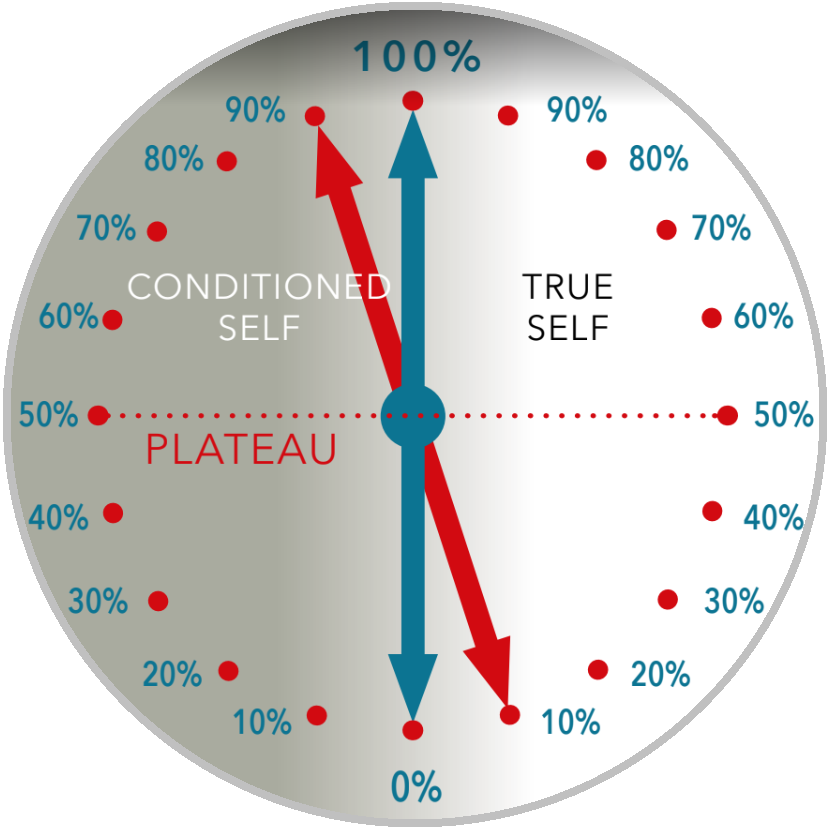
(Revell 2016 – inspired by Carl Rogers PCA. First published in ‘Therapy Today’ BACP magazine April 2019) **
The ACD model is multifunctional. It can be used for trainee counsellors, for client- led assessment and for practicing counsellors. It is visual representation of part of the therapeutic process.
It is a measurement of the ‘here and now’. It measures the clients, ‘direction of movement’ during the therapeutic session/s. It measures the client’s incongruence (conditioned self), which then automatically measures the client’s congruence (true self). The two parts represent the ‘whole’ of the client. The two sides are necessary and useful as they act as a measuring gauge toward self-actualization. Because self-actualization is an ongoing process, there is no ‘final point’ to reach on the model.
Dial A (Blue dial)
Dial A represents the incongruence/unhappiness, as well as the congruence/happiness of the client. On the model incongruence is shown as ‘conditioned self’ and congruence is shown as ‘true self’.
Dial A gives a ‘snap shot’ of how the client feels when they first enter therapy. The measurement can be repeated periodically throughout therapy. It can also measure the overall progress made at the end of therapy. The model fully adheres to the PCA – hence the client being the expert will always measure themselves. This is a slow moving and dial will only move when deep psychological change takes place.
At the beginning of therapy, it is very useful to see the level of incongruence within the client. The gap between the ‘conditioned self’ and ‘true self’ is where a big part of the therapeutic work lies. The objective of course is for the client to move away from the conditioning, towards a more authentic way of being. It is also useful to note that If the gap is extreme it does not necessarily mean that the client will have to endure countless therapy sessions. Of course, all clients are unique, which means that some clients will be able to move towards authentic living quicker than others. It really depends on the client’s situation and environment.
Dial B (Red dial)
Dial B is the quicker moving dial. It can swing from one extreme to another from moment to moment, in just one session. Let’s look at an example:
Client – ‘Today my boss has told me that she wants me to do a presentation to the entire office. I am terrified. How does she expect me to do this? This isn’t even part of my job description. Why is she putting me through this? It will be a disaster and I will make a total fool of myself’. (Big swing into the ‘conditioned self-zone).
Swiftly followed by:
Client – ‘But you know what the crazy thing is? I know I am more than capable of doing this. In fact, I want to show her how capable I am. I have presented in the past and I can do it again’. (dial swiftly moves into the ‘true self- zone’.)
The benefits of following this model allows therapists to track the clients narrative more easily. It can prevent the therapist becoming confused around contradictions, or when the client switches from one subject to another for instance. Understanding how these two dynamics, (sides), work together, allows the therapist to understand why the client may present in confusing ways sometimes. The ‘push and pull’ dynamic of the two sides can create such scenarios. Dial B is usually in a constant state of flux because of this. There are exceptions to the rule, however.
The Plateau
Looking at the model there is a line which goes horizontally across the middle. Both ends of the line are at 50%. When a client is on the plateau it can be a challenging time – not only for the client but for the counsellor too. The reason behind this is that neither the ‘conditioned side ‘or the ‘true side’ are more dominant – they are as equal. The effect of this is that the client feels like both sides are pulling them in opposite directions. It can feel like a psychological ‘tug of war.’ This can create much anxiety for the client, as it can feel as though they are being torn apart emotionally. The result can cause the client to become ‘stuck’ and frustrated. The client may remain at this level for many weeks. If the counsellor is unaware that this process is occurring a parallel process may occur. They too may feel stuck and start to feel frustrated.
Therefore, it is hugely beneficial for the therapist to have a good understanding of this part of the process. A parallel process is less likely to occur, and frustration will be replaced because of a fuller understanding of the therapeutic process itself. Also, when the therapist feels less frustrated then there is less likelihood that they will start to become directive, (even on a subconscious level). The therapist becoming more directive at this stage could result in the client’s anxiety levels elevating even higher, which could result in them wanting to quit therapy all together. This is a very precarious stage of the therapeutic process. Both sides within the client can be hypervigilant. Therefore It is imperative, that the client is given space to fully explore the two sides, especially so at this point. Of course, as therapists, we all hope for positive changes within our clients – but it is at this stage, perhaps more so than any other, that the client needs to work out for themselves which direction they wish to go. It can be a very difficult time for the client as they may feel that the very thing that is keeping them together, (the conditioned side), is the very thing that they want to let go of. It can be a very fearful time for the client.
Some clients may remain at this level for many sessions, however, for others they may move through this stage a lot quicker. It really depends on the client’s circumstances and environment. It must also be noted, that when a client is on the plateau, there is never the assumption or guarantee that they will move towards self-actualization. They may feel the pull towards the ‘conditioned self’ is just too strong. It may take many attempts for the client to move through this stage. For some clients it is far too difficult and perhaps not the right time.
This ACD model is totally based on the PCA. Carl Rogers used various measuring methods whilst developing the PCA – including the Q sort test. Measurements were vital to his research. This model has been created to help understand this process on a visual level. It was also created to try and revive this extremely important part of Rogers work.
** Permission for the ACD model to be copied or used must be obtained. Please use contact form on this website.